
Eyewear Sample Approval Checklist: What Buyers Should Confirm Before Mass Production
A practical B2B guide for eyewear brands and buyers reviewing samples before mass production. Learn how to compare the actual sample with agreed requirements, record revisions, distinguish open items, and understand what requires separate evidence.
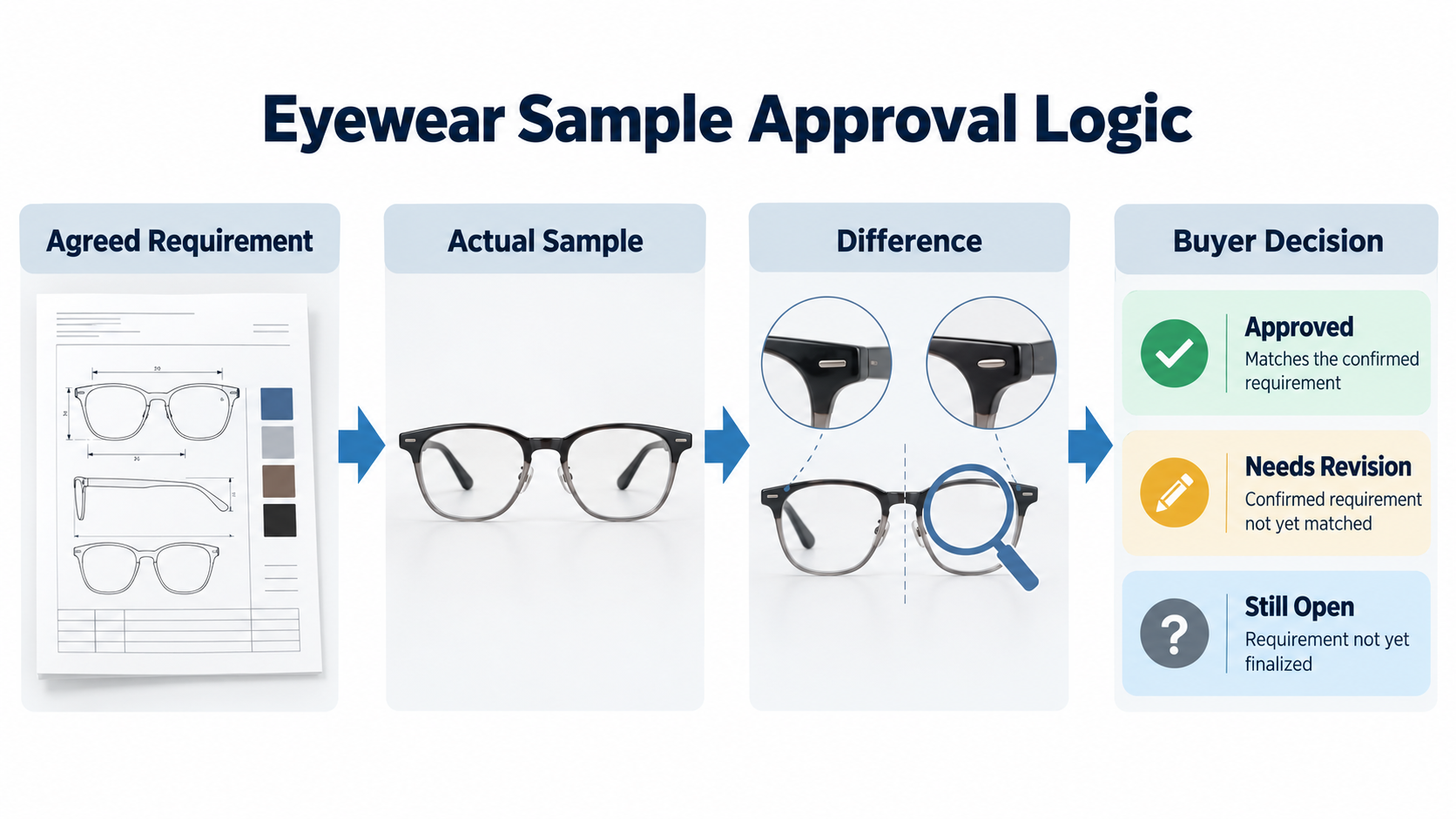
Before approving an eyewear sample for mass production, buyers should compare the actual sample with the product requirements already confirmed for the project, identify any differences, and decide whether each item is Approved, Needs Revision, or Still Open.
Sample approval is not simply about whether the eyewear “looks right.” It is a comparison between what was agreed and what the sample actually delivers.
It is also different from factory quality control. Buyer sample approval asks whether the sample matches the agreed product and brand requirements. Factory QC addresses whether production output meets the applicable approved product and quality requirements.
A sample that looks correct does not automatically prove product performance, test results, or regulatory compliance. Those areas may require separate specifications, testing, documentation, or other supporting evidence. Buyers should also understand how this stage connects with the overall eyewear manufacturing process before moving toward mass production.
For each review item:
The difference between Needs Revision and Still Open is important. The first means the target is already known but the sample does not yet match it. The second means the target itself still needs to be decided.
1. What Does Eyewear Sample Approval Actually Mean?
Eyewear sample approval is the buyer's decision about whether the sample represents the product that has been agreed for the project.
The key question is:
The sample should therefore be reviewed against the project's confirmed requirements rather than against a general idea of what a “good” pair of eyewear should look like.
Depending on the project, these requirements may cover the product version, materials, dimensions, color, finish, lenses, branding, components, assembly, fit, packaging, and other order-specific details.
Do Not Confuse an RP Prototype with the Sample Approved Before Mass Production
In HECHANG Optical's custom eyewear development process , an RP prototype may be used at an earlier product-development stage after the drawings have been completed.
An RP prototype belongs to an earlier development stage and is not the same as the sample reviewed by the buyer before mass production.
This guide focuses on the later decision: whether the buyer is ready to approve the actual product sample for the next stage of the order.
2. Start with the Agreed Requirements, Not Memory
Before reviewing the sample, go back to the information previously confirmed with the manufacturer.
Do not approve a sample simply because it looks close to what you remember.
Depending on the project, review the relevant references for:
- product style, model, or version;
- materials;
- color and finish;
- dimensions and fit;
- lens requirements;
- branding and logo details;
- components and structural details;
- packaging; and
- other confirmed purchasing requirements.
If a requirement was never finalized, do not automatically treat a difference as a manufacturing error. Mark the item as Still Open and resolve the requirement before it becomes relevant to production.
If you are still preparing the information needed at an earlier stage of development, see our Custom Eyewear Manufacturing Checklist: What Should Buyers Provide to the Factory? .
3. Eyewear Sample Approval Checklist: Compare Requirement vs. Sample
Instead of treating sample approval as a series of isolated visual checks, use the same decision process for each review area:
- Agreed Requirement: What was previously confirmed?
- Actual Sample: What does the physical sample show?
- Difference: Is anything different?
- Buyer Decision: Approved, Needs Revision, or Still Open?
3.1 Product Identity and Version
First confirm that you are reviewing the correct product.
Check whether the sample corresponds to the intended:
- style or model;
- color variation;
- current version or revision, where applicable; and
- changes previously requested.
Am I reviewing the correct version of the product?
A well-made sample can still be the wrong sample if it reflects an earlier revision, the wrong color option, or a change that was supposed to have been updated.
- Approved: The correct product and version have been received.
- Needs Revision: A previously confirmed change is not reflected in the sample.
- Still Open: The final version or variation has not yet been decided.
3.2 Overall Appearance, Color, and Finish
Compare the visible appearance of the sample with the visual direction already confirmed for the project.
Review relevant details such as:
- overall styling;
- confirmed frame or lens color;
- surface finish;
- decorative details; and
- other agreed appearance requirements.
If a color, finish, or visual detail has not yet been finalized, record it as Still Open rather than allowing the sample itself to become the default specification.
3.3 Dimensions and Fit
Dimensions and fit should also be reviewed against the requirements established for the project.
Depending on the product, this may include:
- agreed key measurements;
- overall frame proportions;
- fit;
- wearing experience; and
- other project-specific size requirements.
Does the sample match the dimensions and fit requirements agreed for this project?
If a measurement differs from a confirmed requirement, mark it as Needs Revision.
If the measurement itself has not yet been finalized, mark it as Still Open.
Do not apply a generic tolerance or universal fit standard unless a specific requirement has been agreed for the project.
3.4 Materials, Lenses, and Components
Compare the materials, lenses, and components with the specifications confirmed during development.
Relevant items may include:
- frame material;
- lens specification;
- hinges;
- structural components;
- accessories or small parts; and
- other specified components.
Does the sample correspond to the material, lens, and component specifications agreed for the project?
Seeing a sample or wearing it does not by itself prove a particular material property or lens performance claim.
Where technical performance matters, it should be verified separately through the appropriate specifications, testing, documentation, or other supporting evidence rather than inferred from appearance alone.
3.5 Branding and Logo
Branding should be compared with the information already confirmed for the project.
For HECHANG projects, buyers may need to review items such as:
- correct logo artwork;
- logo position;
- logo size; and
- the visual result of the branding on the product.
Where a particular branding process has already been agreed, the sample should also reflect that requirement.
Does the branding on the sample match the agreed artwork, position, size, and execution?
A logo may look acceptable at first glance but still need revision if its size, placement, or execution differs from what was confirmed.
3.6 Assembly and Usability
The sample should also be reviewed as a complete physical product rather than only as a collection of visual details.
Depending on the project, buyers may review:
- hinges and structure;
- component assembly;
- lens seating;
- opening and closing;
- general handling;
- wearing experience; and
- other relevant use-related details.
This does not mean the buyer is carrying out the manufacturer's full quality-control process.
Does the sample function and handle as expected based on the confirmed product requirements?
If a functional or assembly detail differs from what was agreed, record the difference clearly and identify the required change.
3.7 Packaging
Packaging should be reviewed when it forms part of the product or order requirements.
Compare the actual packaging with what was previously confirmed, including relevant items such as:
- packaging type;
- visual appearance;
- branding;
- product presentation; and
- other project-specific packaging details.
Does the packaging match the requirement agreed for this project?
The purpose is not to judge packaging against a generic industry preference. It is to verify whether the delivered result matches the project requirement.
4. What Can Be Approved from a Sample—and What Requires Separate Evidence?
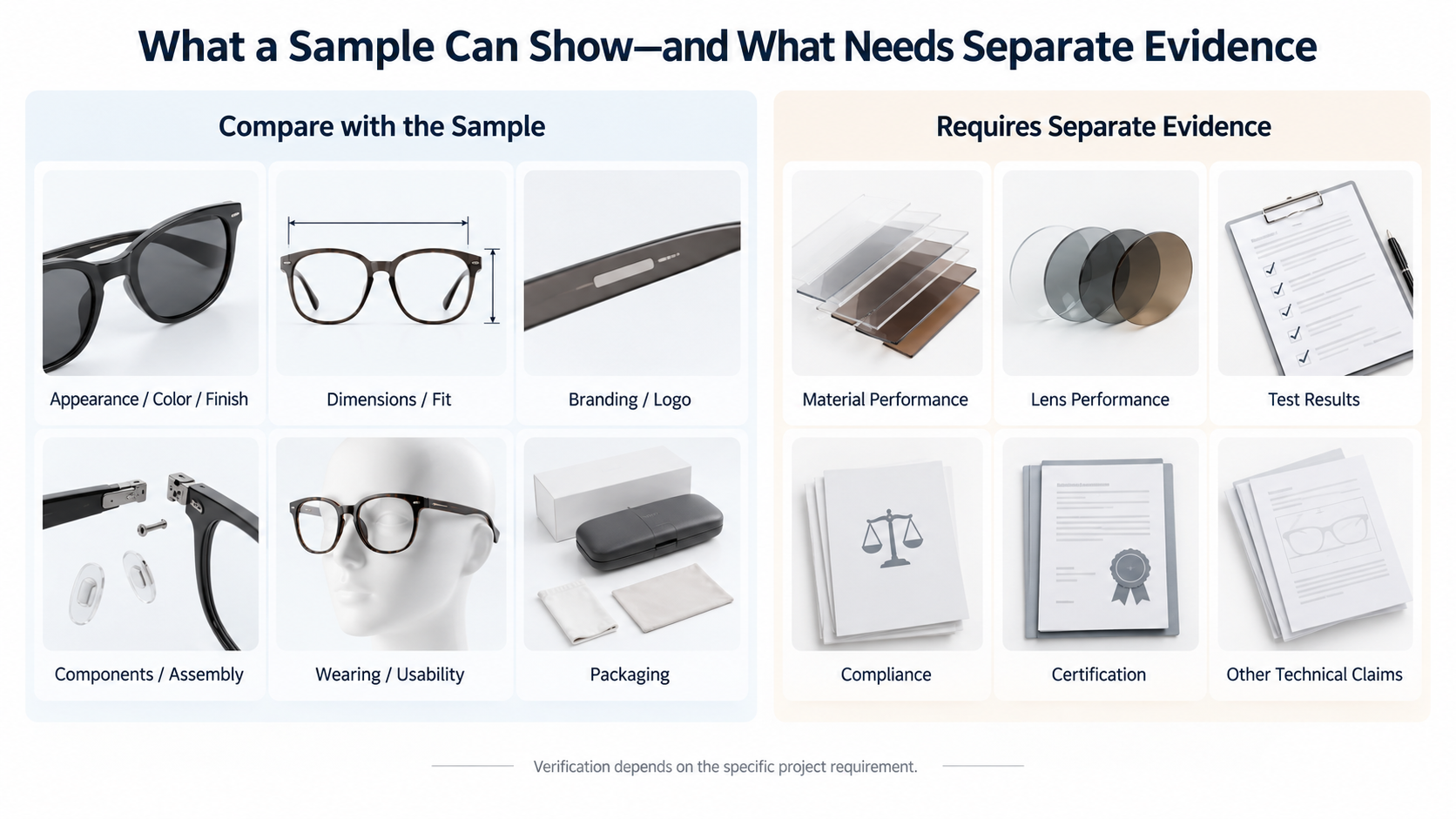
One of the most important parts of sample approval is understanding what the physical sample can—and cannot—demonstrate.
What Buyers Can Often Compare Directly
When requirements have already been defined, the sample can often be used to compare observable or usable details such as:
- product version;
- overall appearance;
- color;
- finish;
- dimensions;
- fit;
- logo position and size;
- assembly;
- usability; and
- packaging appearance.
What Cannot Be Proven from Appearance Alone
A sample that looks correct does not automatically prove:
- material performance;
- lens performance;
- test results;
- regulatory compliance;
- certification status; or
- other technical performance claims.
These observable details are still comparisons against the specific requirements of the project, not universal pass-or-fail standards.
Where these requirements apply, they should be addressed through the appropriate specification, testing, documentation, or other relevant verification.
Buyer approval and technical verification are related to the same product, but they are not the same decision.
5. How Should Buyers Record Sample Feedback?
A useful sample review should leave a clear record of what was accepted, what needs to change, and what remains unresolved.
HECHANG does not use one single confirmation format for every project. Depending on how the project is managed, confirmation may be documented through email, WhatsApp, or another communication method used for the project.
The channel matters less than the clarity of the decision.
| Status | Meaning |
|---|---|
| Approved | The sample matches the confirmed requirement. |
| Needs Revision | A confirmed requirement is not yet matched and needs adjustment. |
| Still Open | The requirement itself has not yet been finalized. |
For each issue, record clearly:
- what was reviewed;
- what matches;
- what is different;
- what needs to change;
- what result is expected; and
- the current decision status.
“The logo is not right.”
A more useful comment identifies which logo detail is different, where the difference appears, what had previously been agreed, and what needs to change.
Clear feedback helps reduce different interpretations of the same revision request.
6. What If the Sample Needs Changes?
Finding an issue does not necessarily mean the entire sample must be treated as unacceptable.
When a difference is identified, the buyer should clarify:
- what is different;
- which confirmed requirement it should match; and
- what result is expected after the change.
HECHANG can then address the relevant revision and determine the appropriate next confirmation step with the buyer.
Whether another physical sample is needed depends on the required change, the project situation, and the buyer's confirmation needs.
Some changes may require another physical sample. In other cases, another suitable confirmation method may be sufficient.
There is no single confirmation method that applies to every revision.
Buyers should therefore avoid assuming either that every change requires another shipment or that every change can be approved remotely.
7. What Must Be Confirmed Before Mass Production Starts?
Sample approval is an important project milestone, but it is not the only consideration before mass production. Buyers should also make sure they are working with a suitable eyewear manufacturer that can support the confirmed production requirements.
The product requirements relevant to the order should be confirmed before production begins.
Depending on the project, these may include:
- sample or product version;
- materials;
- color;
- dimensions;
- lenses;
- branding and logo requirements;
- components;
- packaging;
- order quantity; and
- other order-specific product details.
Items that are still Still Open should be resolved before they become relevant to production.
Payment and other commercial conditions are handled according to the individual order agreement. Sample approval does not mean that a fixed payment condition automatically applies, and payment itself is not the same as product approval.
HECHANG has also confirmed that the sample approved by the buyer before mass production can serve as a production reference for the subsequent order.
This does not mean the sample needs to be described as a “Golden Sample,” “PP Sample,” or another standardized term. The relevant point is that the buyer-approved physical sample can provide a reference for the product that has been confirmed.
8. Buyer Sample Approval Checklist — Quick Summary
Use the following table as a final review of the project requirements and the actual sample.
| Review Item | Compare Against | Buyer Decision |
|---|---|---|
| Product / Version | Confirmed style, model, variation, and revision | Approved / Needs Revision / Still Open |
| Appearance | Confirmed overall product appearance | Approved / Needs Revision / Still Open |
| Color / Finish | Confirmed color and surface finish | Approved / Needs Revision / Still Open |
| Dimensions / Fit | Confirmed measurements and fit requirements | Approved / Needs Revision / Still Open |
| Materials / Lenses / Components | Confirmed product specifications | Approved / Needs Revision / Still Open |
| Branding | Confirmed logo artwork, size, position, and execution | Approved / Needs Revision / Still Open |
| Assembly / Use | Confirmed structural and usability requirements | Approved / Needs Revision / Still Open |
| Packaging | Confirmed packaging requirements | Approved / Needs Revision / Still Open |
| Open Issues | Requirements not yet finalized | Resolve before they become relevant to production |
| Final Decision | All relevant project requirements | Approve or request further revision |
That distinction makes sample approval clearer, easier to document, and more useful as the project moves toward production.
If you are preparing or reviewing samples for an eyewear project, share your project requirements with HECHANG Optical using the inquiry form below.
FAQ
What should I compare when approving an eyewear sample?
Compare the physical sample with the product requirements already confirmed with the manufacturer. Depending on the project, this may include the product version, appearance, dimensions, materials, lenses, branding, assembly, fit, and packaging. Record each relevant item as Approved, Needs Revision, or Still Open.
Is sample approval the same as factory quality inspection?
No. Buyer sample approval determines whether the sample matches the agreed product and brand requirements. Factory quality inspection addresses whether production output meets the applicable approved product and quality requirements.
Does every sample revision require a new physical sample?
No. Whether another physical sample is needed depends on the type of change, the project situation, and the buyer's confirmation needs. The appropriate confirmation method should be agreed for the specific revision.
Does sample approval mean mass production can start immediately?
Not necessarily. Relevant product requirements should be confirmed before mass production, and applicable commercial and payment terms must also be fulfilled according to the individual order agreement.
Does approving a sample prove product performance or compliance?
No. Sample approval can confirm whether observable product details match the agreed requirements, but it does not by itself prove technical performance, test results, certification status, or regulatory compliance.

How to judge the quality of a pair of glasses?

Create Your Perfect Look with HECHANG Optical's Custom Sunglasses: Tailored for Style and Comfort

Top Lens Material News: Latest Trends & Innovations
Custom Eyewear Manufacturing Checklist: What Should Buyers Provide to the Factory?

Customizable Orange Sports Sunglasses S434

Wholesale Sleek Geometric Gradient Lens Sunglasses OLD7460

Customized fashion sports glasses KF-278

Wholesale Round Slim Metal Frame Fashion Sunglasses OLD7461
Submit Your Request Now!
Before diving into our services, please take a moment to fill out the corresponding form, detailing the type of eyewear you wish to import from China. Whether it's sunglasses, optical frames, reading glasses, or children’s glasses, we are committed to providing you with tailored solutions that meet your needs. Let us know your preferred materials, whether you require matching glasses case packaging, or any other specific requirements you may have.
Rest assured that your privacy is important to us, and all information provided will be handled with the utmost confidentiality.

MANUFACTURING ROOTS DATING BACK TO 1976.
Specializing in OEM and ODM eyewear manufacturing for international brands, HECHANG Optical serves customers across Europe, the United States, Japan, Australia, India, Russia, and other global markets. More about ↗
We’re here


 Scan QR Code